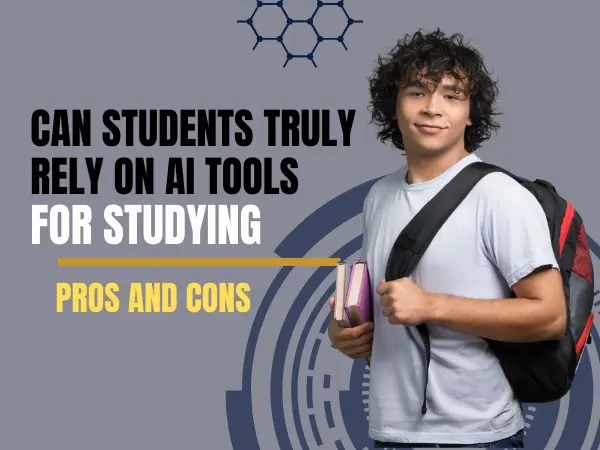

The integration of Artificial Intelligence (AI) tools into education has been one of the most transformative shifts in academia this decade. From advanced language models to personalized tutoring platforms, AI promises to revolutionize how students learn, research, and prepare for assessments. However, as these tools become ubiquitous, a critical question emerges: Can students truly rely on AI tools for studying, and at what cost?
This comprehensive analysis delves into the substantial benefits and inherent risks of integrating AI into the student workflow, exploring whether these digital assistants are powerful allies or dangerous crutches.
I. The Rise of the AI Study Partner
The modern student is no longer confined to textbooks and lecture notes. Tools like ChatGPT, Gemini, specialized paraphrasers, and AI-powered grammar checkers have become readily accessible, offering instantaneous support across various academic domains. This accessibility has fundamentally altered the landscape of self-study and assignment completion.
II. The Case for Reliance: Key Advantages of AI in Education (The Pros)
AI tools offer students several compelling benefits that enhance efficiency, personalize learning, and overcome traditional academic hurdles.
1. Instantaneous and Personalized Tutoring
Traditional education often struggles to provide personalized attention due to high student-to-teacher ratios. AI bridges this gap effectively.
- 24/7 Availability and Instant Feedback: AI assistants can field questions at any hour, providing immediate explanations and feedback that drastically speeds up the learning cycle. Unlike human tutors, AI does not sleep and never judges.
- Tailored Explanations: A student struggling with a complex concept (e.g., quantum mechanics or calculus) can ask an AI to explain the topic using an analogy relevant to their interests (e.g., “Explain quantum entanglement using a sports metaphor”). This level of adaptive instruction significantly improves comprehension.
- Adaptive Practice: Many AI platforms and tools, especially those integrated into courseware, can dynamically adjust the difficulty of practice problems based on the student’s real-time performance, ensuring they are always challenged but never overwhelmed.
2. Enhanced Efficiency and Time Management
AI excels at automating repetitive and time-consuming administrative tasks, freeing up valuable cognitive resources for deeper learning.
- Rapid Summarization and Analysis: Students can feed an AI a 50-page academic paper or a long lecture transcript and receive a concise summary of the main arguments, key findings, and methodologies in seconds. This greatly accelerates literature reviews and research preparation.
- Drafting and Outlining: AI can instantly generate structured outlines for essays, research proposals, or presentations. While the student must fill the content, the organizational backbone is provided, overcoming the hurdle of staring at a blank page.
- Language and Editing Support: Tools like Grammarly and QuillBot ensure that the final output is grammatically flawless and stylistically professional. This is particularly beneficial for students whose first language is not the language of instruction.
3. Breaking Down Language and Access Barriers
AI can make complex, global information accessible to a wider audience, democratizing education.
- Instant Translation: Students can access research, lectures, and academic papers published in any language and instantly translate them for comprehension, expanding their academic reach far beyond local resources.
- Simplification of Complex Text: AI can paraphrase highly technical or jargon-filled academic texts into simpler language without losing the core factual meaning, aiding students with different reading comprehension levels or cognitive load issues.
4. Supporting Non-Traditional Learners
AI tools offer unique support for students with different learning styles or specific needs.
- Visualizing Concepts: Advanced AI image and video generators (even in their free tiers) can create visual aids or diagrams to illustrate abstract concepts, helping visual learners grasp ideas that text alone cannot convey.
- Audio Learning: Text-to-speech AI provides high-quality narration, allowing students to convert lecture notes or reading materials into audio for learning on the go.
III. The Perils of Over-Reliance: Critical Disadvantages and Ethical Concerns (The Cons)
While the benefits are significant, an uncritical reliance on AI tools introduces profound risks that can undermine the integrity of education and inhibit core skill development.
1. Erosion of Core Skills and Critical Thinking
The most significant danger of over-reliance is the degradation of fundamental academic skills.
- Loss of Writing Muscle: When AI consistently handles outlining, drafting, and editing, students lose practice in organizing arguments, developing unique voice, and struggling through the intellectual rigor of composing a coherent piece of text.
- Weakened Research Skills: If an AI summarizer replaces the act of reading a 50-page paper, the student misses the crucial opportunity to evaluate the methodology, assess the sources’ credibility, and extract their own nuanced interpretation. The skill of synthesizing complex information is bypassed.
- Calculation Dependency: Over-reliance on tools for complex math problems can lead to a failure to grasp the underlying mathematical principles or the steps required to arrive at a solution, crippling the ability to solve non-standard problems manually.
2. Accuracy, Hallucination, and Information Vetting
AI models are sophisticated prediction machines, not definitive knowledge repositories. This fundamental nature leads to flaws in academic integrity.
- Hallucinations: AI models frequently “hallucinate”—generating entirely false but highly plausible-sounding information, citations, or data. Students who do not cross-reference this output risk integrating misinformation into their work.
- Source Credibility: Many AI models do not reliably cite sources or may cite non-existent sources, forcing the student to undertake even more labor-intensive research to verify the AI’s claims.
- Outdated Information: Free or older AI models may be trained on data sets that are several years old, making them unreliable for fields that require current information, such as technology, current affairs, or rapidly evolving scientific research.
3. Academic Integrity and the Cheating Dilemma
The use of AI for assignment completion blurs the line between legitimate academic aid and plagiarism.
- Detection and Penalties: While AI detectors are imperfect, institutions are rapidly developing sophisticated methods to flag AI-generated content. Students face serious academic penalties, including failing grades and expulsion, for submitting work that is not their own.
- Ethical Grey Area: Even with minor editing, the ethical question remains: if an AI generates 80% of the content and structure, does the resulting work represent the student’s mastery of the subject matter? The reliance on AI undermines the fundamental purpose of assessment.
4. Privacy and Data Concerns
Using proprietary AI tools means students are entrusting their academic data, thoughts, and inquiries to a third-party company.
- Data Usage: The terms of service for many popular free AI tools permit the company to use user inputs to train and improve future versions of their models. This means a student’s private essay drafts, research ideas, or sensitive questions could become part of a public data set.
- Vulnerability: Relying on third-party servers for essential academic processes (like note-taking or drafting) creates vulnerability to service outages, data breaches, or changes in subscription models.
IV. Striking the Balance: Effective Integration
The solution is not outright rejection, but thoughtful and responsible integration. Students must learn to use AI as a collaborator, not a replacement.
| Strategy | AI Tool Function (Collaborator) | Inherent Risk (Replacement) |
| Synthesis & Organization | Generating a list of keywords or a first-draft outline. | Asking AI to write the entire paper. |
| Fact-Checking | Using AI to quickly find an initial list of supporting sources. | Assuming the AI’s generated facts or citations are correct. |
| Skill Practice | Creating personalized quizzes or practice problems on specific topics. | Using AI to solve problems without showing the steps. |
| Clarity | Checking grammar and rephrasing confusing sentences. | Relying on AI to generate sophisticated vocabulary you don’t understand. |
V. Conclusion: Ally, Not Authority
The consensus in 2025 is clear: AI tools are indispensable allies in the academic journey, offering unmatched capabilities in personalization, efficiency, and accessibility. However, they must never be treated as the ultimate authority.
True reliance on AI for studying means relying on it to enhance one’s own capabilities, not outsourcing the intellectual process entirely. Students must cultivate a mindset of skeptical collaboration, constantly vetting AI outputs, prioritizing the development of core critical thinking skills, and viewing the AI output as a starting point—never a final destination.
The future of education belongs to those who learn to work with artificial intelligence, harnessing its speed and power while retaining the essential human skills of judgment, ethical reasoning, and original thought. Relying on AI is possible, but only when the human mind remains firmly in the driver’s seat.