
In 2025, the barrier to learning any new skill—whether it’s Python programming, financial modeling, or public speaking—has effectively vanished. The secret isn’t just having access to information; it’s having a personalized tutor that adapts to your pace.
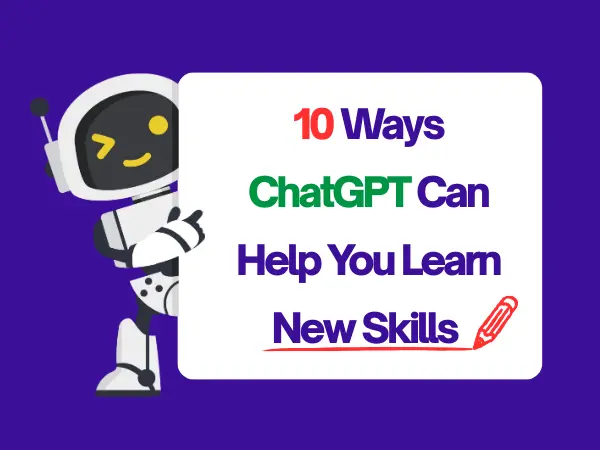
ChatGPT is that tutor. But to get the best results, you need the right “scripts.” Here are 10 powerful prompts to transform ChatGPT into your personal learning assistant and accelerate your growth.
1. The Skill Learning Roadmap (Planning)
Starting is the hardest part. This prompt builds a structured path so you never feel lost.
Prompt: “I want to learn [Skill Name] from scratch. Create a week-by-week learning roadmap for 4–8 weeks with daily goals, topics, and recommended resources.”
Why it works: it breaks a massive goal into digestible daily chunks, preventing “choice paralysis.”
2. The Concept Simplifier (Understanding)
Stuck on a difficult theory? Use the “Feynman Technique” through AI.
Prompt: “Explain [Complex Concept] to me like I’m 12 years old. Use simple examples or analogies to help me understand it clearly.”
Pro-Tip: Analogies are the “glue” of memory. If you can understand a concept as an analogy, you’ve truly mastered it.
3. The Interactive Tutor (Engagement)
Don’t just read; interact. This prompt turns ChatGPT into a Socratic teacher.
Prompt: “Act as a tutor and teach me [Topic]. Ask me small questions to test my understanding as we go. Don’t move to the next topic until I answer correctly.”
4. Custom Practice Exercises (Application)
Theory is useless without practice. Get tailored drills for your specific needs.
Prompt: “Give me 10 hands-on exercises to practice [Skill]. Include real-world examples or case studies for each.”
5. The Progress Tracker (Milestones)
Knowing where you stand is vital for motivation.
Prompt: “Help me track my progress while learning [Skill]. Create a checklist or milestone tracker with key concepts I should master at each level — beginner, intermediate, advanced.”
6. The Mistake Detector (Feedback)
AI is excellent at spotting patterns in your errors.
Prompt: “I’m learning [Skill]. Here are some of my mistakes or challenges: [list your challenges]. Analyze them and explain what I’m doing wrong and how to fix it.”
Why it works: It provides an immediate feedback loop, which is the fastest way to improve any skill.
7. Learn by Teaching (Synthesis)
Teaching is the best way to learn. Use this prompt to test your own clarity.
Prompt: “Pretend I’m teaching [Skill] to someone else. Give me a short summary script to explain it simply and confidently in my own words.”
8. Real-World Project Ideas (Portfolio)
Skills are most valuable when they produce something. Build your portfolio with these ideas.
Prompt: “Suggest 5 mini-projects or real-world tasks to practice [Skill] and build a portfolio. Include clear goals and difficulty levels for each project.”
9. The 30-Minute Daily Routine (Consistency)
Consistency beats intensity. This prompt fits learning into a busy schedule.
Prompt: “Design a 30-minute daily learning plan for [Skill]. Include what to read, practice, or watch each day to stay consistent.”
10. The Knowledge Refresher (Review)
Did you learn something a year ago and forget it? Don’t start from zero.
Prompt: “I learned [Skill] a while ago but forgot most of it. Create a 7-day refresher plan that covers the core essentials to get me back up to speed.”
Final Advice for AI-Powered Learning
While ChatGPT is an incredible tool, remember that AI is your co-pilot, not the pilot. To truly master a skill:
- Verify Facts: AI can occasionally “hallucinate” facts. Cross-reference technical data.
- Do the Work: Don’t let ChatGPT write the code or the speech for you—let it guide you while you do the heavy lifting.
- Stay Curious: If you don’t understand an answer, ask “Why?” until it clicks.